Your desk, drawn to your body.
An interactive blueprint of the workstation that fits you. Enter your height, watch the drawing redraw itself, leave with your numbers.
Your elbows set the height.
Seated work starts at the forearms: parallel to the floor, shoulders hanging loose. For most adults that lands the desk surface between 27 and 30 inches. Most fixed desks are built at 29 or 30. One height, for every body that ever sits at one.
Enter your height. We draw the rest.
Five measurements define a workstation that fits: desk height seated, desk height standing, seat height, eye line, and viewing distance. Set the slider to your height and read yours off the drawing. They are starting points, not laws. Fine-tune until your elbows rest at about 90 degrees and the top of the screen sits at eye level.
COPIES YOUR NUMBERS + A LINK THAT REDRAWS THEM
Drawn from standard body-proportion tables. Bodies differ in the middle: long torso, short femur, tall sitter. Treat every number as a first pencil mark and calibrate by feel, with shoulders unloaded and wrists flat.
A desk that moves needs a cadence.
The most cited starting rhythm comes out of Cornell's ergonomics lab: for every half hour at the desk, sit for about 20 minutes, stand for 8, and move for 2. A 2015 expert statement in a British sports-medicine journal points the same direction, building toward 2 to 4 hours of upright time across a working day.
You don't need a stopwatch. You need a rough sense of the split, and a desk that makes the switch cost nothing.
Each cell is one half-hour cycle. The split is a starting cadence, not a prescription: the win is changing position often, not hitting the minutes exactly.
From drawing to desk.
Sheets 01 to 03 are theory. This is the desk they were drawn against: the UPLIFT V3 build documented across this site, photographed during setup. The full tour covers every piece on it, what it costs, and how it has held up.
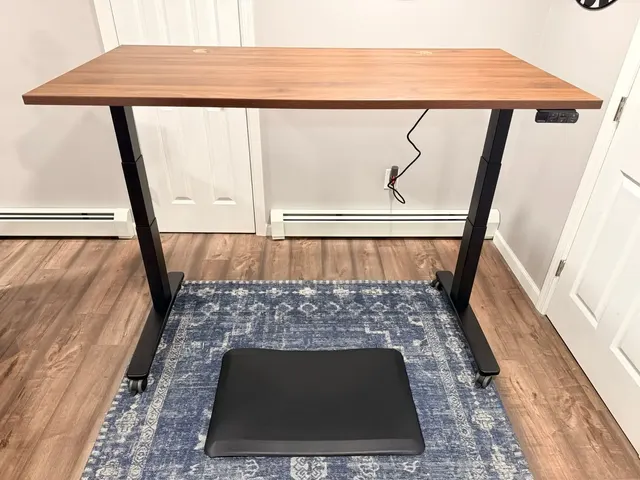

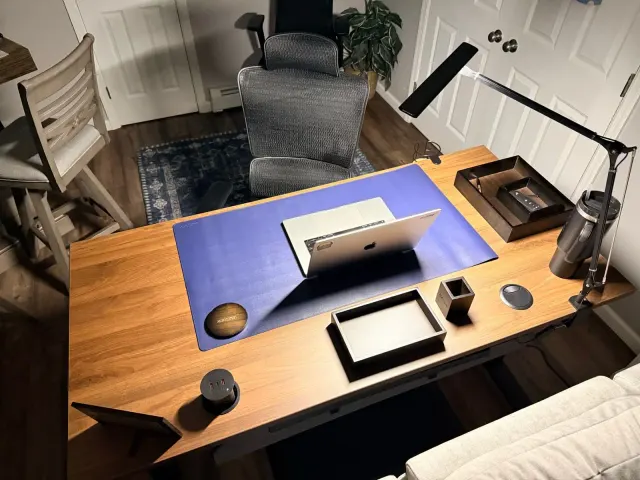
The blueprint is free. The parts are real.
Three pieces turn the drawing into a desk: a frame that moves, a chair that fits the seated half, and something for the move minutes. These are the ones behind the photos above. This page contains affiliate links.
Send someone their numbers.
The link carries your height, so the blueprint opens already drawn. Set it to a friend's height first and it becomes theirs.